Floor Crossing in Canada: Parliamentary Rules, Legal Framework, and Constitutional Debate
- Sara Santos-Vigneault

- Apr 18
- 6 min read
Written by: Sara Santos-Vigneault
Date: April 18, 2026

What Is Floor Crossing in Canada
Floor crossing refers to the practice of an elected Member of Parliament (MP) changing political affiliation after being elected. This may involve leaving one political party to join another or choosing to sit as an independent member. Members who cross the floor retain their seat in the House of Commons unless they resign or are otherwise disqualified under applicable law. [1]
Legal Status of Members of Parliament
In Canada, Members of Parliament are elected to represent their constituencies as individuals, even though they typically run as candidates affiliated with a political party.
Once elected, the legal status of an MP does not depend on continued membership in that party.
If a Member chooses to leave their party or join another, they retain their seat and continue to represent the same electoral district without requiring a new election. [1][2]
This reflects a core feature of Canada’s parliamentary system, in which the seat is held by the individual Member rather than the political party. However, this legal structure has been the subject of significant and ongoing public criticism. Reporting across multiple media outlets has described concerns that voters often cast ballots based on party platforms, leadership, and policy commitments, and that a change in party affiliation after an election may undermine those expectations and alter the representation originally endorsed by voters. [3][4][5]
At the same time, there is no legal requirement for a Member who changes affiliation to seek a renewed mandate from voters, and no statutory penalty or automatic consequence tied to such a decision. This gap between the legal structure and voter expectations is one of the central reasons the practice remains controversial. [1][2]
Oath of Office and Legal Obligations
Before taking a seat and voting in the House of Commons, a duly elected Member must swear or affirm an oath of allegiance. Section 128 of the Constitution Act, 1867 requires Members to take and subscribe the Oath of Allegiance contained in the Fifth Schedule. [6][7]
This oath is made to the Crown and is a formal legal requirement for holding office. It does not require a Member to remain affiliated with a political party, nor does it impose a legal obligation to maintain the political position under which the Member was elected. [6][8]
Members are also subject to ethics rules, including the Conflict of Interest Act, which require them to avoid conflicts of interest and improper personal gain. However, these rules govern financial and ethical conduct, not political affiliation. There is no legal duty requiring an MP to remain with a party or to follow the platform under which they were elected. [9]
As a result, while public discussion often frames floor crossing in terms of trust or representation, the legal obligations imposed on Members of Parliament do not restrict their ability to change political alignment once elected.
Why Floor Crossing Is Permitted
Floor crossing is permitted in Canada because there is no constitutional or statutory rule prohibiting it. The Constitution Act, 1867 establishes Parliament and its structure but does not require Members to remain with the political party under which they were elected. [6][10]
This reflects broader parliamentary principles, including responsible government and the idea that elected representatives act as individual office holders. Political parties are central to parliamentary life, but party affiliation itself is not legally binding. [1][2]
Absence of Legislative Restrictions
At the federal level, the Canada Elections Act governs how elections are conducted, including candidate nominations, voting, and campaign rules, but it does not regulate what happens if an elected Member later changes party affiliation. [11]
Similarly, parliamentary practice does not require a Member to vacate a seat or face a by-election after joining another caucus. A Member who crosses the floor may simply sit with the new party or as an independent. [1]
This has led to a recurring public question:
why is there no legal rule requiring a fresh vote when the political affiliation under which the Member was elected changes?
The answer lies in the structure of Canadian parliamentary law, which treats the seat as belonging to the Member rather than the political party. [1][2]
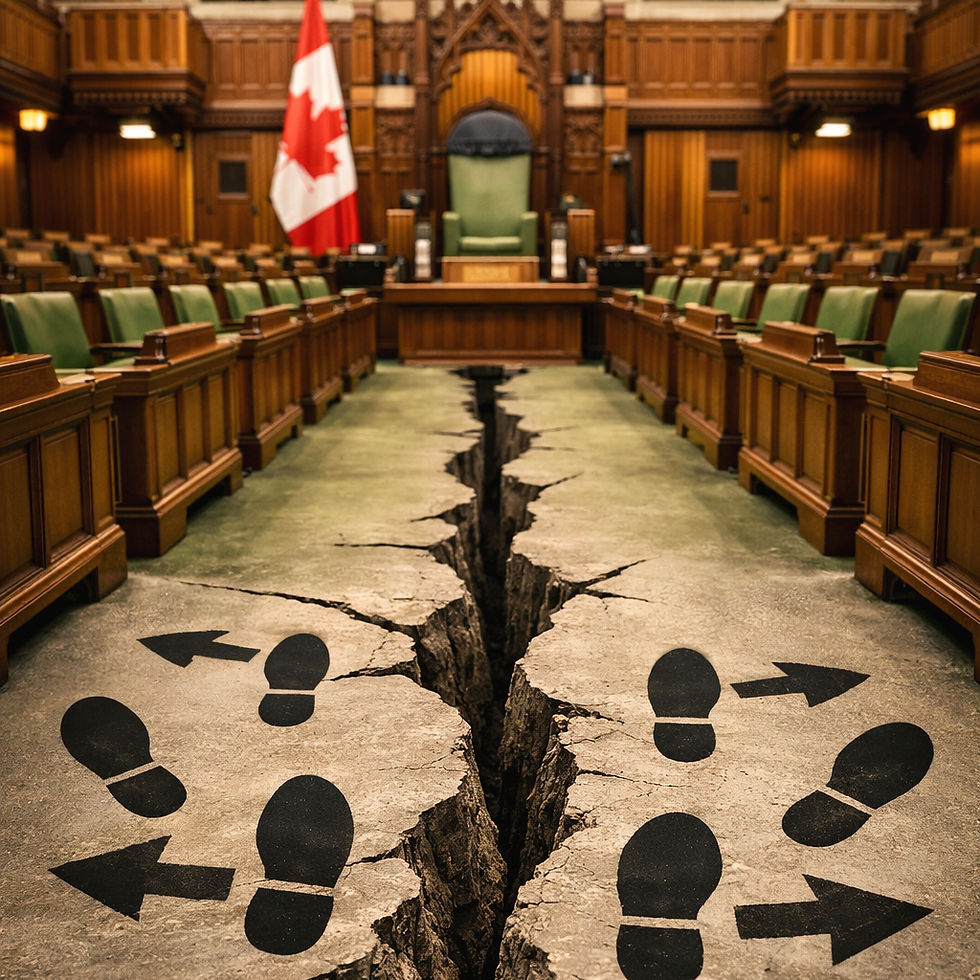
Recent Examples and Public Response
Recent floor crossing has brought renewed attention to the issue, particularly because of its direct impact on the balance of power in Parliament. Reporting indicates that a series of defections from opposition parties to the governing Liberals between late 2025 and early 2026 contributed to the government reaching a majority position in the House of Commons. [3]
The Members involved in these recent crossings included Chris d’Entremont, Michael Ma, Matt Jeneroux, Lori Idlout, and Marilyn Gladu.
These individuals moved from opposition parties, primarily the Conservatives and the New Democratic Party, to join the Liberal caucus over a relatively short period. As a result of these defections, combined with subsequent by-election results, the Liberals reached approximately 174 seats in the House of Commons, forming a majority government during the same parliamentary term without a general election. [3][4][5]
Several of the Members publicly explained their decisions:
Chris d’Entremont stated that the government’s budget “hits the priorities I have heard most in my riding.”
Michael Ma stated that he entered politics “to focus on solutions, not division.”
Matt Jeneroux indicated that leadership and policy direction had “opened a lot of eyes.”
Marilyn Gladu stated that joining the Liberals was the “best thing” for her riding, the country, and herself. [4][5][12][13]
At the same time, these decisions drew strong criticism. Opposition responses described the shift in parliamentary control as inconsistent with the results of the previous election, raising concerns about whether such changes reflect the original mandate given by voters. [3]
The controversy has been further heightened by the fact that at least one of the Members involved had previously supported the idea that floor crossing should trigger a by-election, contributing to broader debate about whether the current legal framework aligns with public expectations of accountability. [13]
These developments have made floor crossing a more immediate and visible issue. While the legal rules have not changed, the political consequences have become more significant, particularly where changes in party affiliation affect the overall control of government.
Compensation, Roles, and Public Discussion
Members of Parliament receive a base salary and allowances established by law, and these do not change based solely on party affiliation. However, additional compensation is associated with specific roles, such as cabinet positions, parliamentary secretaries, and committee chairs. [14]
When a Member crosses the floor and joins a governing party, their position within Parliament may change. Membership in the government caucus can influence access to committee roles, speaking opportunities, and participation in legislative decision-making. Members may also be considered for additional roles that carry greater responsibility and compensation. [15]
Public and Legal Debate
Floor crossing continues to generate debate in Canada, particularly in relation to democratic accountability. Critics argue that voters often make their decisions based on party affiliation, and that a change in party after an election may not reflect the choice made at the ballot box. [3][4][5]
Recent events have intensified these concerns by demonstrating that floor crossing can influence not only party composition, but the balance of power in Parliament itself. [3]
At the same time, others argue that restricting floor crossing could undermine the independence of Members of Parliament. The ability to act independently is considered by some to be an important safeguard within the parliamentary system. [1][2]
Constitutional Context
The legal framework governing floor crossing in Canada remains unchanged. Members of Parliament continue to hold their seats in an individual capacity, and no statutory mechanism requires a by-election or other formal process when a change in party affiliation occurs. [1][2][11]
Within this framework, the Constitution, the oath of allegiance, and federal election law consistently recognize Members of Parliament as independent office holders rather than representatives legally bound to a political party. At the same time, recent developments have highlighted the extent to which this legal structure can intersect with public expectations regarding electoral choice and representation.
References
[1] The Canadian Encyclopedia – “Floor Crossing”
[2] The Canadian Encyclopedia – “Political Party”
[3] Reuters – “Canada’s Carney set to win majority government in special elections” (April 2026)
[4] Reuters – “Canadian MP Chris d’Entremont resigns Conservative caucus to join Liberals” (November 2025)
[5] Reuters – “Carney on verge of majority after opposition MP defects” (March 2026)
[6] Constitution Act, 1867, s. 128 (Oath Requirement)
[7] Constitution Act, 1867, Fifth Schedule – Oath of Allegiance
[8] House of Commons Procedure and Practice – “Oath or Solemn Affirmation of Allegiance”
[9] Conflict of Interest Act, S.C. 2006, c. 9, s. 2
[10] Constitution Act, 1867 (General Provisions)
[11] Canada Elections Act, S.C. 2000, c. 9
[12] Associated Press – “Canada’s Liberals near majority after another Conservative defection” (2026)
[13] Associated Press – “Carney attracts another Conservative lawmaker to Liberal Party” (2026)
[14] Parliament of Canada – “Indemnities, Salaries and Allowances”
[15] House of Commons – “Parliamentary Secretaries”


Comments