Section 145 of the Criminal Code: Why "Just a Breach" Charge Carries Real Legal Weight in Canada
- Sara Santos-Vigneault

- Apr 20
- 10 min read
Updated: Aug 2
Written by: Sara Santos-Vigneault
Date: August 2, 2026
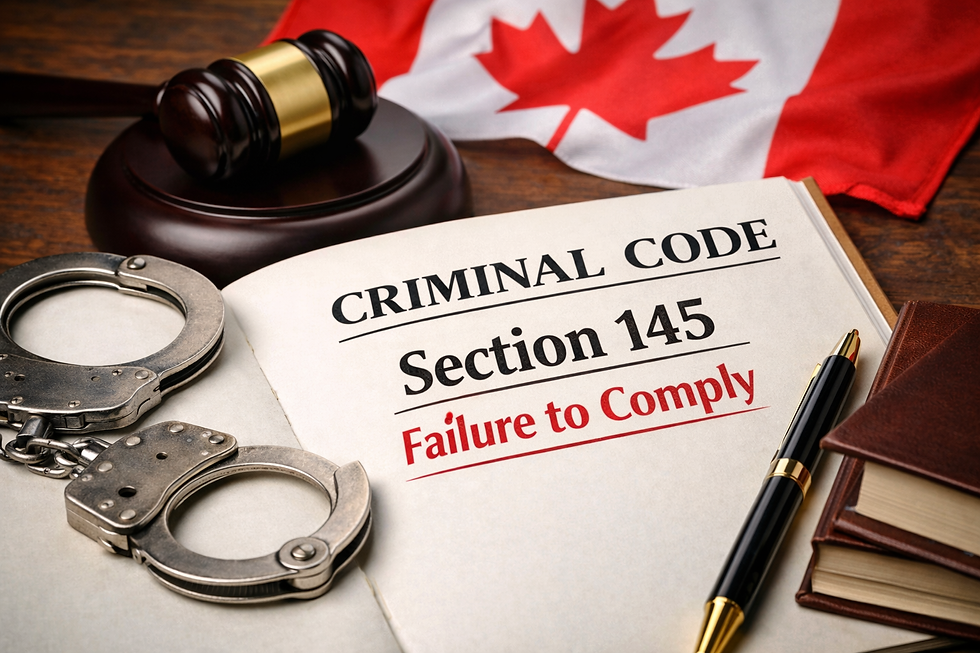
Every year, hundreds of thousands of Canadians are released from custody while their criminal charges work their way through the courts. Almost all of them are handed a list of conditions to follow: report to a supervisor, respect a curfew, avoid a certain person, stay away from a certain neighbourhood, surrender a passport. For most people, following those conditions is straightforward. For many others, it is not — and the consequences of getting it wrong are more serious than they might expect.
In Canadian criminal law, a court order is not a suggestion. Once an undertaking or release order is in place, the obligation to follow it becomes a matter of criminal liability in its own right, entirely separate from whatever charge triggered the conditions in the first place. Section 145 of the Criminal Code is the provision that makes this so, and it is one of the most frequently used — and least understood — parts of the entire Code. [1]
The Supreme Court of Canada has been blunt about how often it comes up. In R v Zora, the Court observed that failure to comply offences make up a significant portion of the administration of justice charges that occupy the country's criminal courts, adding that many of the people caught up in these charges never actually committed an act that most Canadians would think of as criminal. [2]
What Section 145 Actually Covers
Section 145 is not one offence — it is a cluster of related offences, all aimed at ensuring that court process and release conditions are respected. Depending on the subsection, a person can be charged with:
Failing to attend court, or failing to surrender themselves into custody, while released on a court order
Failing to appear in response to an appearance notice, promise to appear, or summons
Failing to comply with a condition of an undertaking given to police or the court
Failing to comply with a condition of a release order made by a judge or justice
Failing to comply with certain orders related to fingerprinting or identification procedures
Each of these can be prosecuted either summarily or by indictment, depending on the circumstances of the case and the Crown's election. That flexibility matters in practice: it allows minor, technical breaches to be dealt with relatively quickly, while more serious or repeated non-compliance can be pursued as an indictable matter with heavier potential consequences. [1]
A Charge With a Life of Its Own
One of the most misunderstood features of section 145 is that it does not depend on what happens to the original charge. A person can be prosecuted for breaching bail conditions even if the underlying offence that got them released in the first place is later withdrawn, stayed, or ends in an acquittal. The breach is treated as its own wrong against the administration of justice, not as an add-on to the original case.
This is why the legal question in a section 145 prosecution is narrow and specific: did a valid order exist, and were its terms not followed without lawful excuse? Whether the person was ultimately guilty of the offence that led to the conditions being imposed is, legally speaking, beside the point. [1]
Where the Conditions Come From: Undertakings and Release Orders
Section 145 arises most often in the bail context. When someone is arrested and not held for a bail hearing, police can release them on an undertaking with conditions attached. When a bail hearing does take place, a judge or justice of the peace can impose a release order, again with conditions designed to address specific, recognized concerns: making sure the accused shows up for trial, protecting public safety, and maintaining public confidence in the justice system. [4]
In practice, this produces a familiar list of conditions: reporting to a bail supervisor on a schedule, curfews or house arrest, geographic restrictions, no-contact conditions naming a specific person, and weapons prohibitions. These conditions are not supposed to be imposed reflexively. In R v Antic, the Supreme Court confirmed that release conditions must be reasonable and necessary, and reaffirmed what is often called the "ladder principle": the law favours release at the earliest reasonable opportunity, on the least onerous conditions that address the actual risks in the case. [3]
Antic itself illustrates what happens when that principle is ignored. Franco Antic, charged with drug and firearms offences, was ordered to post $100,000 in cash bail even though neither he nor his proposed sureties had ready access to that kind of money — despite the fact that a recognizance with sureties, which does not require cash up front, would have served the same purpose. It took him months in custody to raise the funds. The Supreme Court held that the reviewing judge had skipped over the less restrictive options the ladder principle requires courts to consider, and that treating cash as automatically more effective than a pledge was a legal error. Writing for a unanimous Court, Justice Wagner stressed that release is favoured at the earliest reasonable opportunity and on the least onerous grounds, and that each less restrictive rung of the ladder must be rejected before a judge moves to something stricter. [3]
Antic attracted attention because it was widely seen as a corrective to a bail culture that had drifted toward over-caution — piling on conditions and cash requirements more for administrative comfort than because they were legally justified. Its significance lies less in any single legal test and more in the message it sent to bail courts across the country: unnecessary conditions are not a neutral, harmless precaution. They are conditions someone can be criminally charged for breaching, so they should not be imposed lightly.
The Fault Requirement: Why Not Every Breach Is a Crime
The second pillar of the modern law on section 145 is R v Zora, a 2020 decision that changed how breach charges are actually proven. Chaycen Zora had been granted bail on drug charges, subject to a strict curfew and a condition requiring him to come to his door within five minutes whenever police or his bail supervisor checked on him. On two occasions, officers came to his residence late at night and he failed to answer. He was charged under section 145(3), and argued that from his bedroom it had been difficult, if not impossible, to hear anyone at the door. [2]
At trial, and again on appeal to the British Columbia Court of Appeal, the courts held that an objective standard applied — meaning Zora could be convicted if a reasonable person in his position ought to have known they were breaching a condition, regardless of what he actually knew or intended. The Supreme Court disagreed. It ruled unanimously that section 145(3) requires the Crown to prove subjective fault: that the accused knowingly or recklessly failed to comply with their condition, not merely that a reasonable person would have done things differently. [2]
The Court's reasoning went beyond the technical question of mens rea. Justice Martin, writing for the Court, noted that a person can face imprisonment for breaching a bail condition even if they are never ultimately convicted of any of the crimes for which they were initially charged, and pointed out that in many cases the conduct being punished would be perfectly lawful if not for the specific condition imposed — meaning there is often no victim and no direct harm involved. [2]
That framing helps explain why Zora mattered well beyond Mr. Zora's own case. It signalled that the Supreme Court saw the section 145 machinery as one that had, in practice, been sweeping up a great deal of low-level, non-culpable conduct — missed doorbells, misunderstood curfews, minor lapses — and treating it the same as deliberate defiance of a court order. By requiring proof of actual knowledge or recklessness, the Court narrowed the gap between technical non-compliance and criminal liability, without eliminating breach charges altogether. It also used the decision to more broadly criticize the routine overuse of restrictive, hard-to-follow bail conditions, urging release authorities to impose only what is truly necessary — a theme that echoed Antic three years earlier.
"Without Lawful Excuse": The Words That Do a Lot of Work
Section 145 does not criminalize every failure to comply. Several of its subsections apply only where the person failed to follow a condition "without lawful excuse." That phrase recognizes that circumstances can make compliance genuinely impossible or unreasonable — a medical emergency that prevents someone from reporting on time, for example, or an event genuinely outside their control. Whether a particular excuse will succeed depends heavily on the specific subsection charged and the facts of the case, but the language itself is a signal that Parliament did not intend section 145 to operate as a strict liability trap. [1]
Multiple Charges From One Incident
Because each condition in a release order is treated as a distinct legal obligation, a single incident can generate several separate charges. Someone who breaks both a curfew and a no-contact condition on the same night, for instance, is not committing one breach — they are committing two, each prosecuted and recorded separately. This can matter significantly at sentencing and in how an accused's record comes to be viewed by future bail courts, since a pattern of multiple, stacked breach charges can make it considerably harder to be released a second time. [1]

Why This Matters Beyond the Courtroom
The practical stakes of section 145 extend well past the individual charge itself. A breach allegation can trigger a fresh arrest, a bail revocation hearing, and — particularly where the breach involves an allegation of new criminal conduct — a real risk of pre-trial detention on both the original and the new matter. The Department of Justice has identified non-compliance with bail conditions as a factor that can influence how future release decisions are made within the system, meaning a breach on one file can follow a person into how they are treated on another. [4]
This is also where public misunderstanding tends to creep in. It is a common assumption that a breach charge is minor — a technicality, a slap on the wrist. The statistics tell a more complicated story. Administration of justice offences, the broader category that includes section 145 breaches along with failures to appear and breaches of probation, have historically accounted for roughly one in five completed cases in adult criminal court, and government cost estimates have put the annual system-wide cost of these offences — policing, prosecution, legal aid, courts, and corrections — in the hundreds of millions of dollars. Federal officials and provincial justice ministers have flagged the volume of these charges as a policy concern in its own right, distinct from the seriousness of any individual case, and some jurisdictions have reported that these offences make up a disproportionately large share of their overall criminal caseload. There is also a recognized pattern in which administration of justice charges fall more heavily on marginalized and remote communities, where practical barriers — distance from a courthouse, lack of transportation, unstable housing — can make strict compliance with reporting or curfew conditions genuinely difficult, independent of any intention to defy the court. [1][4]
A Shifting Legislative Backdrop
Section 145 does not exist in isolation from the broader bail system, which has itself been the subject of active legislative attention in recent years. In December 2023, Parliament passed Bill C-48, which expanded the circumstances in which an accused person bears a reverse onus at a bail hearing — meaning the accused, rather than the Crown, must justify why they should be released rather than detained. The changes were aimed at repeat violent offending involving weapons and firearms, and at intimate partner violence cases involving a prior conviction or discharge for a similar offence. The legislation followed sustained pressure from provincial and territorial governments and police services concerned about repeat offending among people released on conditions.
The significance of this reform for section 145 is indirect but real: as bail becomes more heavily conditioned and more people are released with an expanded set of restrictions attached, the pool of conditions available to be breached grows as well. Advocacy groups and some academics have raised concerns that reforms focused on tightening bail can, without careful implementation, increase the number of administration of justice charges rather than reduce serious reoffending — a tension that reflects the same balance the Supreme Court wrestled with in Antic and Zora.
Common Misconceptions
A few misunderstandings recur often enough to be worth addressing directly. First, many people assume that being cleared of, or having withdrawn, the original charge automatically clears a related breach charge — it does not; the two are legally independent. Second, there is a tendency to assume that any missed condition automatically results in a conviction; since Zora, the Crown must prove the person knew they were breaching the condition, or was reckless about whether they were. Third, breach charges are sometimes dismissed publicly as trivial paperwork offences, when in practice they can result in detention, additional restrictions, and a criminal record with real consequences for employment, immigration status, and future interactions with the justice system.
Where the Law Stands
Section 145 continues to enforce a basic proposition: court orders carry legal weight of their own, separate from whatever led to them being made. At the same time, the Supreme Court's decisions in Antic and Zora have made clear that this weight is not unlimited. Conditions must be reasonable and necessary in the first place, and proving a breach requires more than showing that a condition was not met — it requires showing that the person knew, or was reckless as to whether, they were failing to comply.
The law in this area continues to develop, both through the courts and through Parliament. Questions remain about how bail reform legislation like Bill C-48 will interact with the volume of administration of justice charges going forward, and how consistently the fault standard set out in Zora is being applied at the trial level across the country. What is settled, for now, is the basic architecture: court orders are meant to be followed, breaches are treated as offences against the administration of justice in their own right, and Canadian law continues to draw a line between simple non-compliance and criminal fault.
References
[1] Canada, Criminal Code, RSC 1985, c C-46, s 145. https://laws-lois.justice.gc.ca/eng/acts/c-46/section-145.html
[2] R v Zora, 2020 SCC 14, [2020] 2 SCR 3, Supreme Court of Canada. https://www.canlii.org/en/ca/scc/doc/2020/2020scc14/2020scc14.html
[3] R v Antic, 2017 SCC 27, [2017] 1 SCR 509, Supreme Court of Canada. https://www.canlii.org/en/ca/scc/doc/2017/2017scc27/2017scc27.html
[4] Department of Justice Canada, "The Bail Process in Canada," Government of Canada. https://www.justice.gc.ca/eng/cj-jp/bail-caution/index.html
[5] Library of Parliament, "Legislative Summary of Bill C-48: An Act to amend the Criminal Code (bail reform)," 2023. https://lop.parl.ca/sites/PublicWebsite/default/en_CA/ResearchPublications/LegislativeSummaries/441C48E
[6] Statistics Canada, "Trends in offences against the administration of justice, 2014," The Daily. https://www150.statcan.gc.ca/n1/daily-quotidien/151015/dq151015c-eng.htm


Comments